Author: Elizabeth Stewart

  • Knowledge

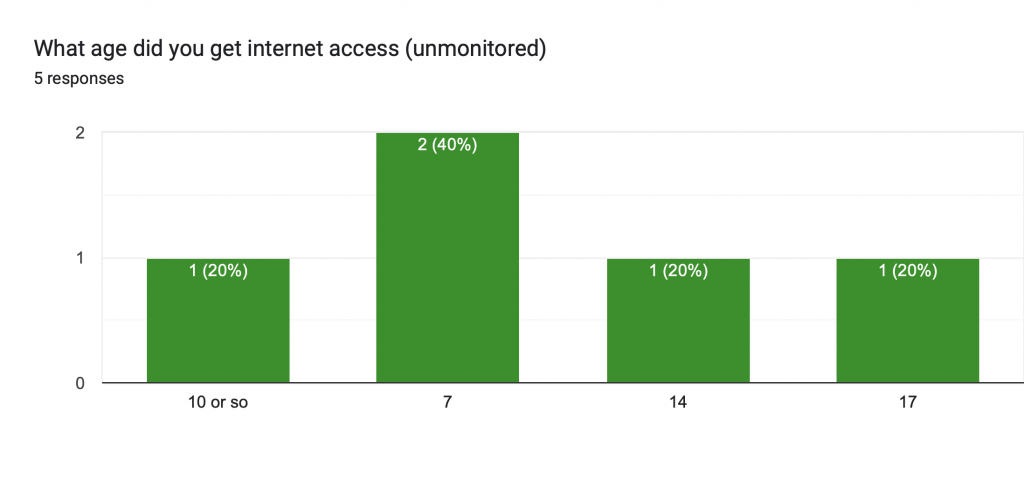
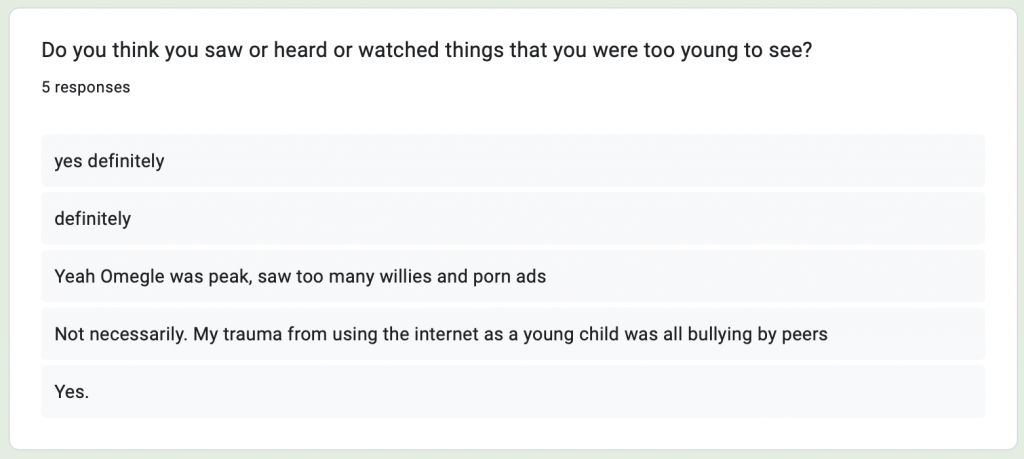
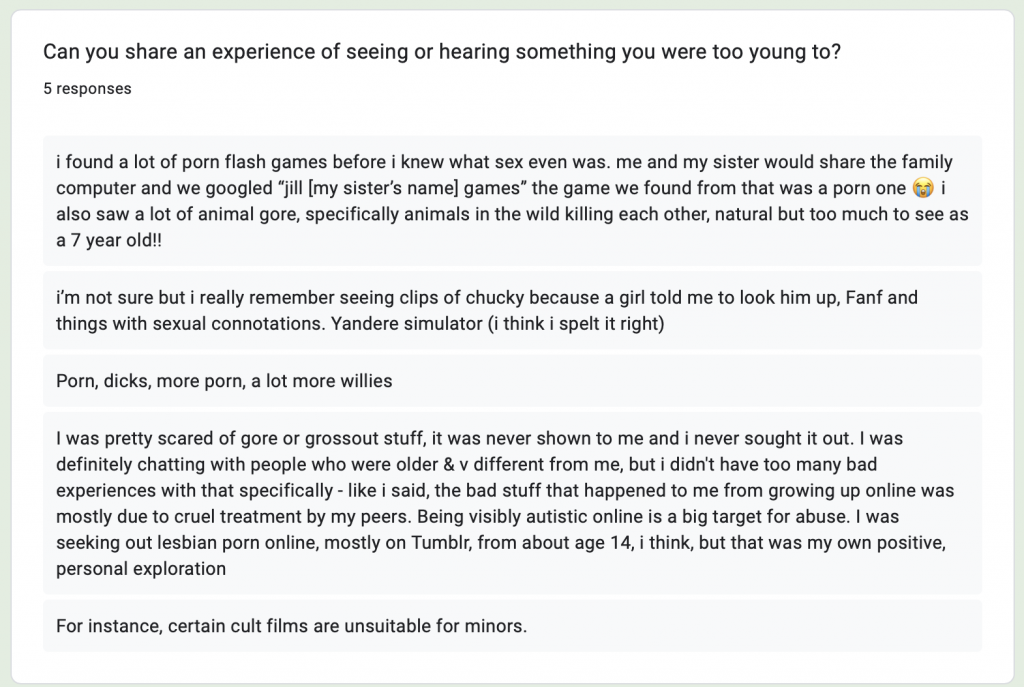
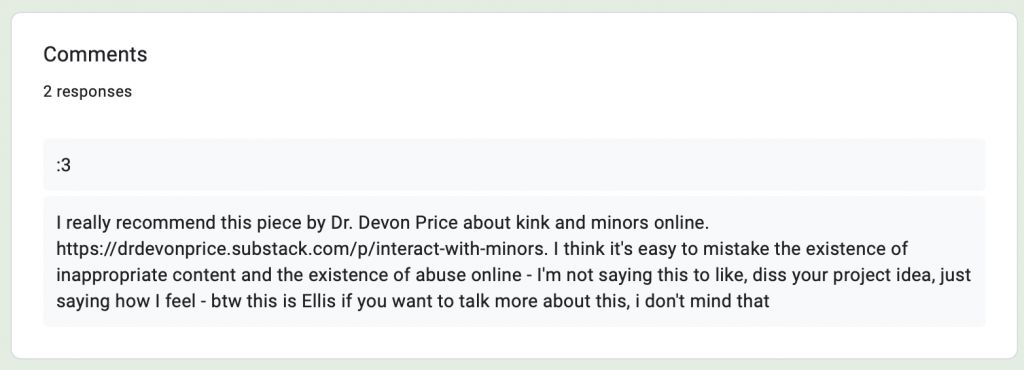
    To develop a more comprehensive understanding of my theme, I conducted a survey designed to capture diverse perspectives and experiences that could further inform my work. The feedback obtained from this survey prompted me to consider aspects of my research that I had not previously taken into account.

    I was particularly interested in the concept of adult content existing online vs abuse. My narrative is exploring the accessibility of adult content and how easily accessible it has been for minors however this is seemingly unclear through my work. This made me really think about how my narrative is communicated and whether I wanted to make it more obvious or lean into the subtlety.

    Ethics of unmonitored access to the Internet:

    • Freedom of information: Access is a human right according to article 19 of the UN declarations of human rights. However should adult content be accessible to those under the legal age of consent?
    • Ethics of monitoring people: People have a right to privacy and autonomy of what they are accessing. However lack of monitoring can lead to the rise of dangerous behaviour such as cyber bullying and predatory behaviour.
    • Protection and harm prevention: Taking into consideration of nonmalificence (Do no harm) requires steps of prevention. This could look like monitoring, age controls, ratings etc.
    • Responsibility and Accountability: Behaviour online is down to individual behaviour. However children are still legally considered a parent’s responsibility and there for their access online should be monitored for safety reasons.

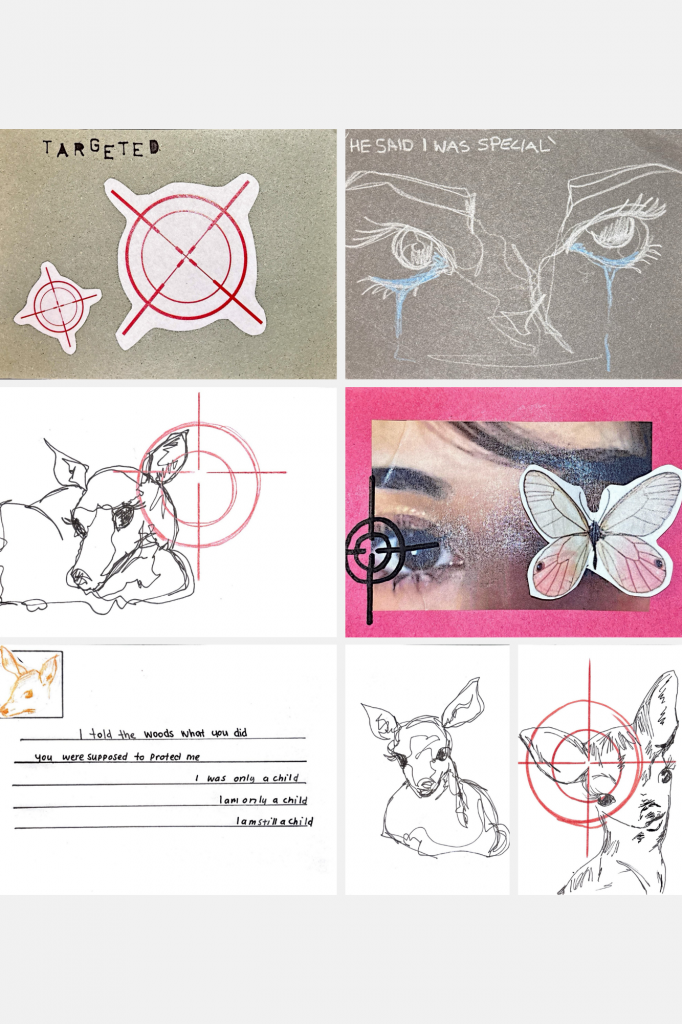
    I also considered my own position of the narrative. I was raised by very involved parents who protected me and what I was able to access on the internet until I was of legal consent age. Even with this monitoring, adult content was still accessible with accounts bypassing the protections etc. With my parents being as involved as they are, I was always honest and open re things that were being shown to me on the internet. This changes how I view this narrative. I was protected and I am approaching this from that viewpoint. I have limited understanding of the other side where it was accessible and one maybe enjoyed accessing it. For me, any inappropriate content, whether age appropriate or not, made me feel targeted. This isn’t the case for others. I want to consider this within my narrative, focusing on a subtlety that others who feel the same as me would notice but is maybe otherwise unnoticeable.

    Adult Content and the Cognitive Affects of it:

    Adult content (pornography) has been shown to seriously affect cognitive behaviour, causing long term damage to young minds. Mental health.com lists the main affects as follows:

    The Pleasure and Reward Center: Dopamine, the brain’s primary reward neurotransmitter, is released whenever a person experiences pleasure. When there is a repetitive release of dopamine over time, the reward center of the brain becomes altered, leaving a person needing more stimulus to achieve the same result. As the brain gets used to the constant highs and lows associated with regular porn use, it starts to create new patterns that drive a person to continue watching pornography. [1]

    Cognitive Function: Individuals who suffer from porn addiction often struggle with cognitive function, exhibiting impaired decision-making. Most notably, this is demonstrated by preferring short-term small gains over long-term large gains. [2] Porn addicts can also have a hard time accurately perceiving the negative consequences of their behavior, which creates a disconnect between their internal moral compass and society’s moral code. 

    Emotional Regulation: Individuals who have difficulty regulating their emotions are more susceptible to reaching for porn in effort to distract themselves. Over time, this pattern can easily morph into a full-blown addiction, leaving them in a cycle of reaching for porn to avoid uncomfortable emotions, only to further dysregulate themselves. ” (Wirth, L. (2025) The brains of porn addictsMentalHealth.com. Available at: https://www.mentalhealth.com/library/the-brains-of-porn-addicts (Accessed: 31 October 2025). )

    This information has influenced my work from a protest view point. The easy accessibility of this content is shown to have a negative affect on brain development, decision making, dopamine factors and still remains unmonitored. Innocence is being taken away through this unmonitored access, for some voluntarily, for some they do not seek it out. This has an impact on how I want to portray my narrative as part of me wants to make it really obvious to raise awareness for this issue.

    Alongside all of this, adult content has previously been accessible from any age and even when reduced to an age limit, is easily bypassed. The legal age of consent in the uk is 16 and there are individuals as young as 7 being exposed to pornography and other content. This in and of itself poses a legal and ethical question: How do we monitor minors and can we realistically create a society where this kind of content is limited until 16 if not 18?
  • Knowledge

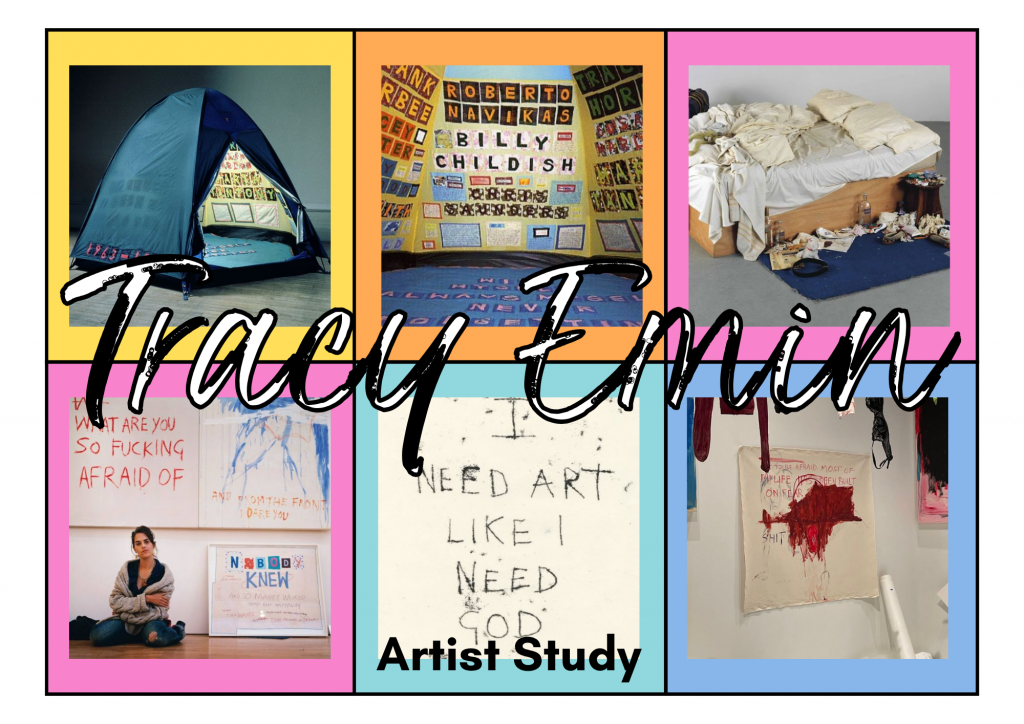
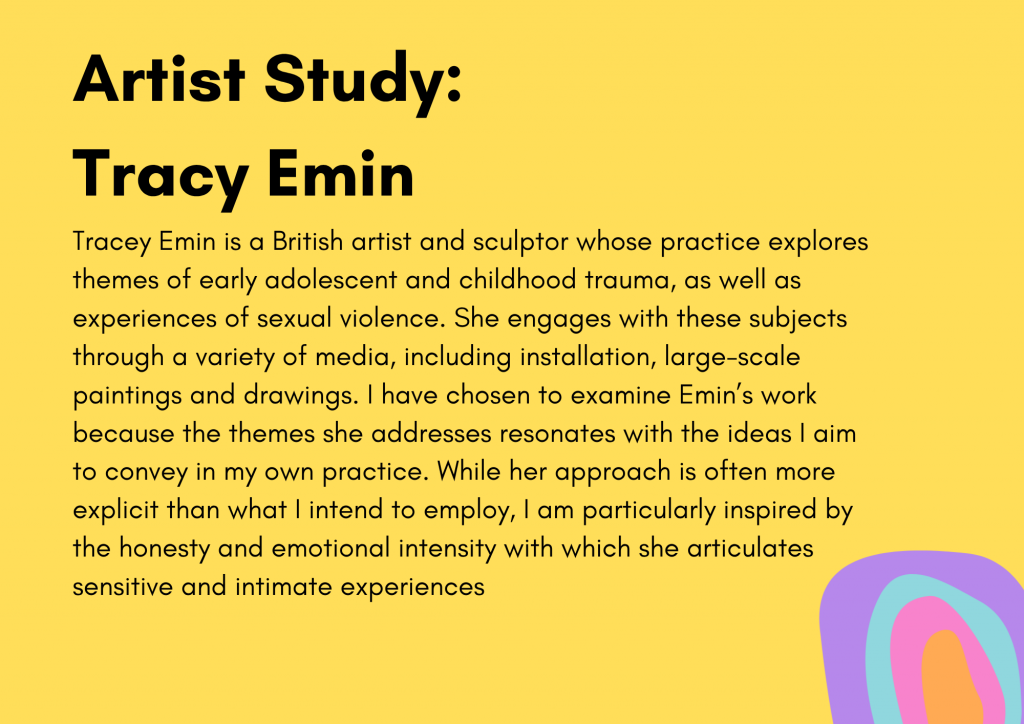
    Tracey Emin

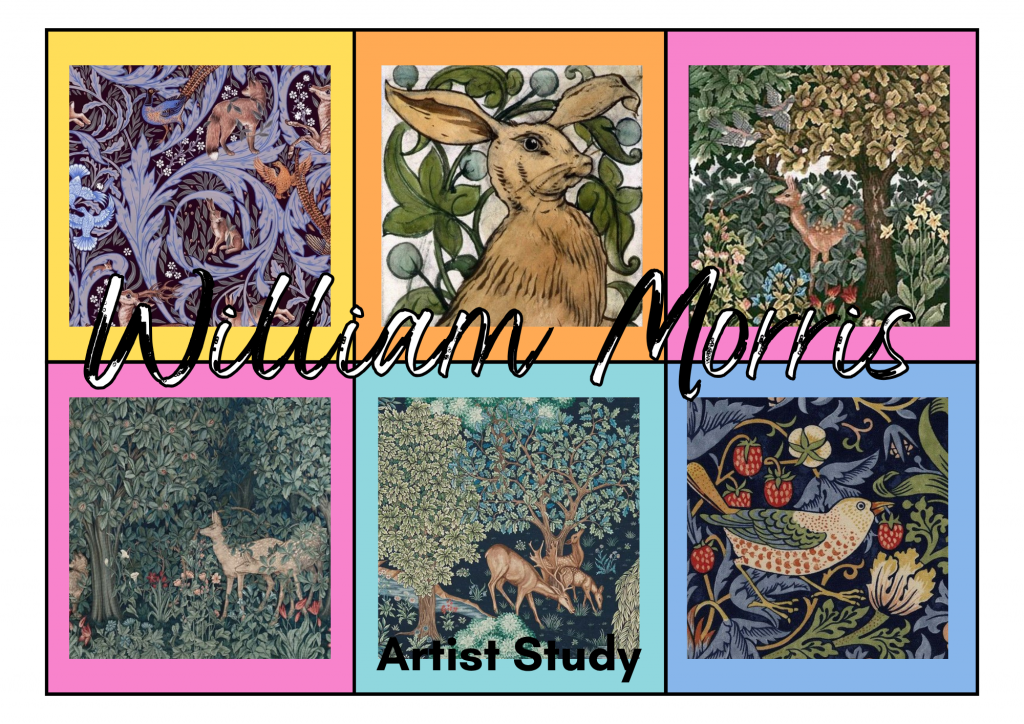
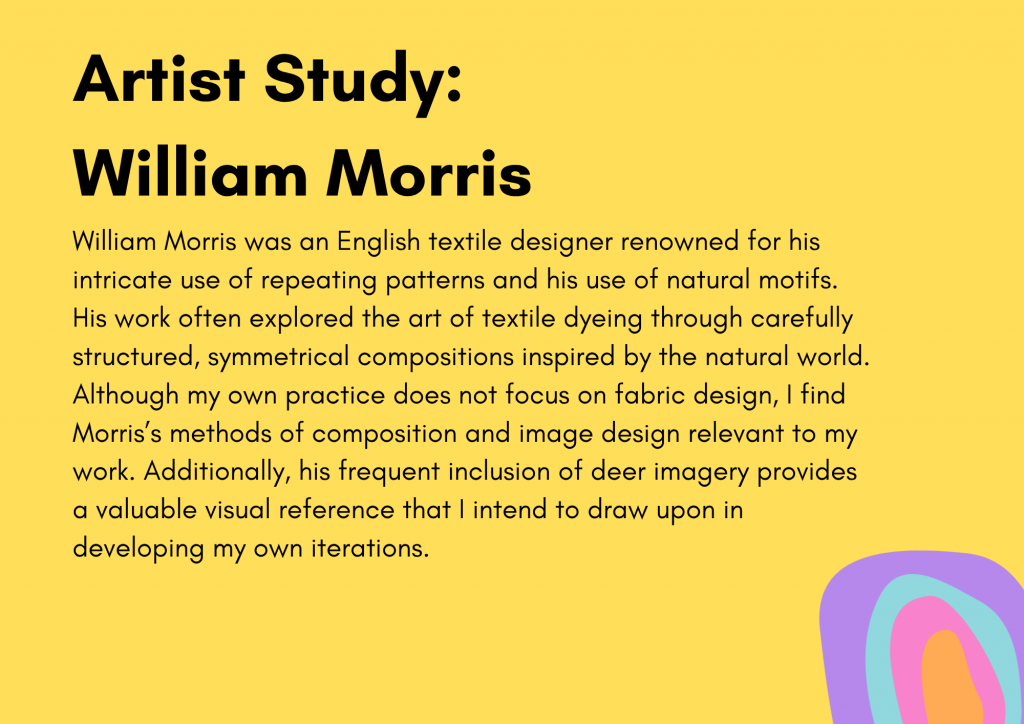
    William Morris

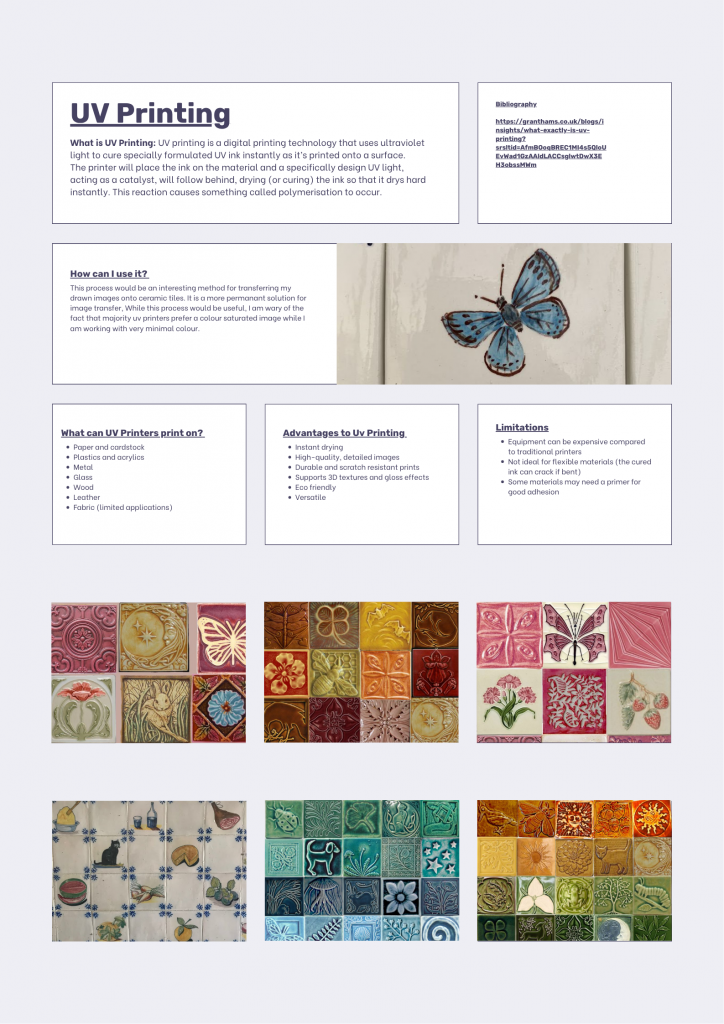
    UV Printing

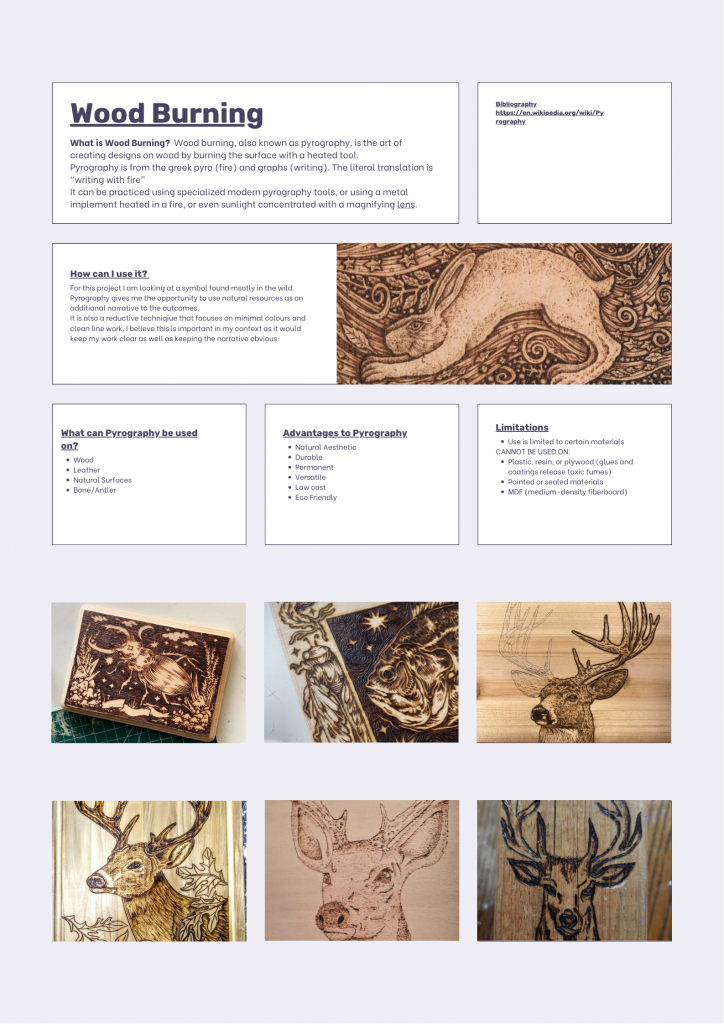
    Wood Burning

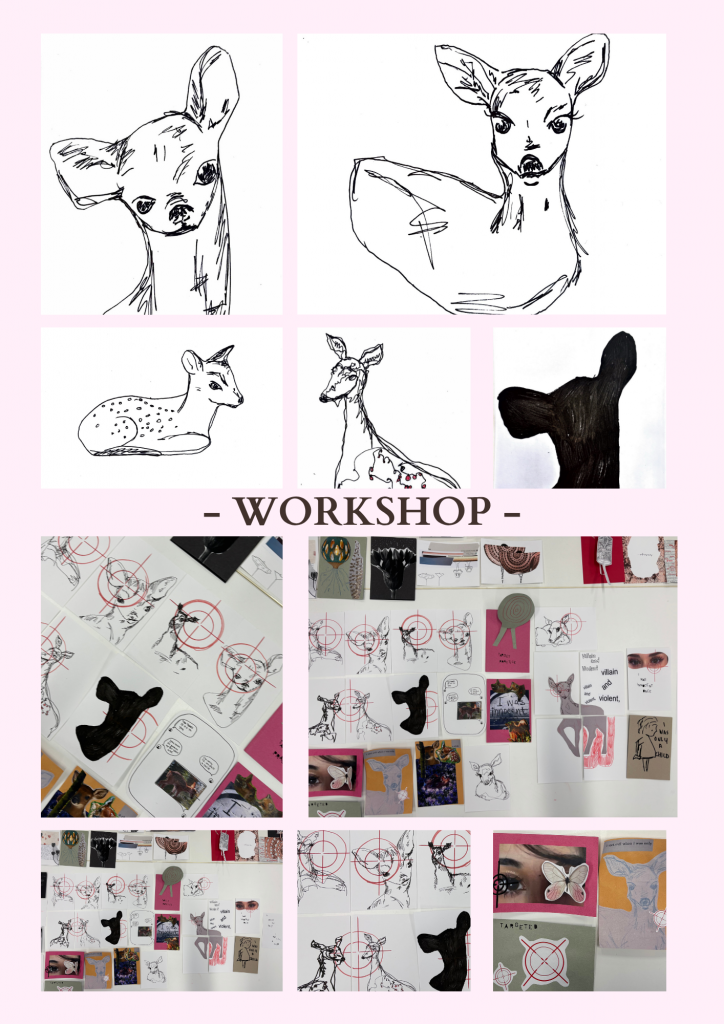
  • Process: Postcard workshop

    As a starting process, we created postcards. We had around 35 minutes to create 10 in a non linear pattern. This could be done through collage, drawing, mark making and other such techniques.

    I focused on drawn/mark making techniques as I knew this was an important element to what I was wanting to create.

    Initial Drawings & Mockups

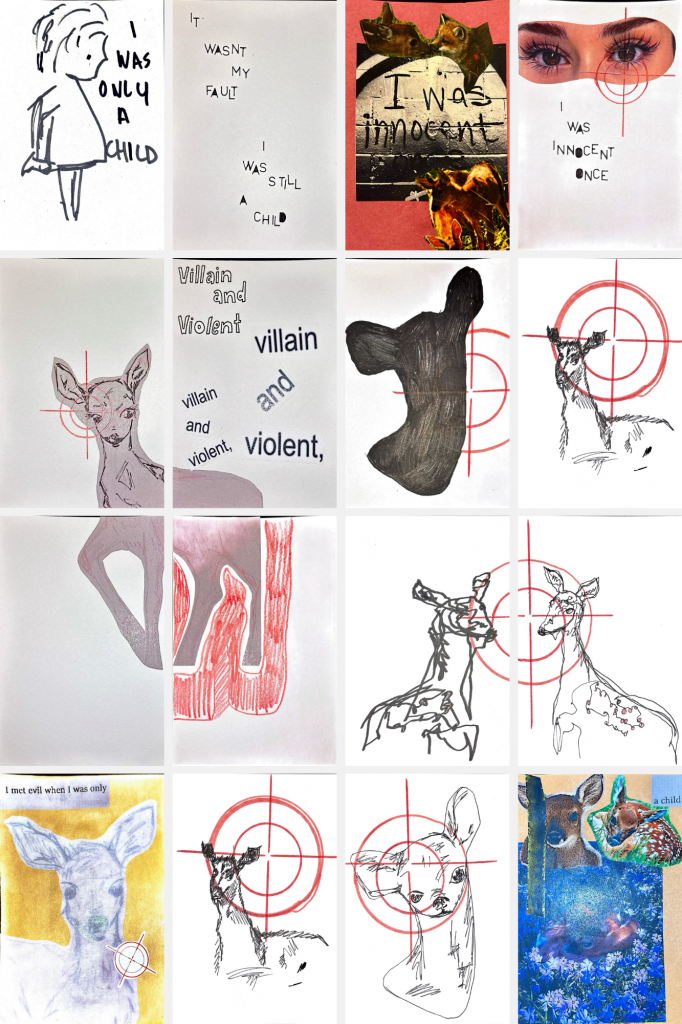
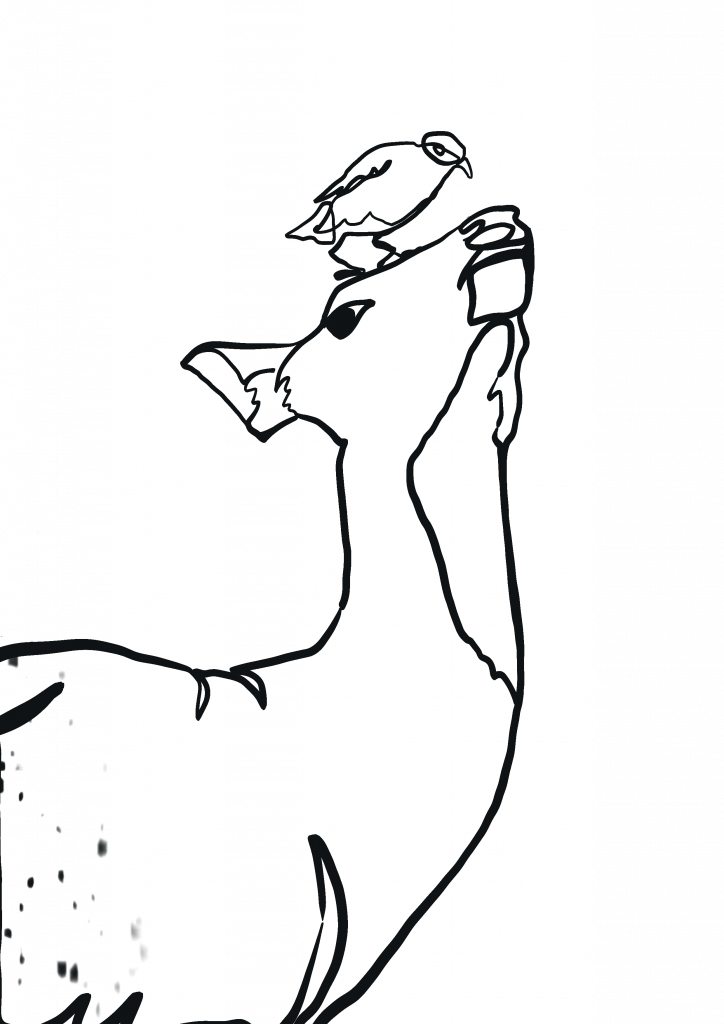
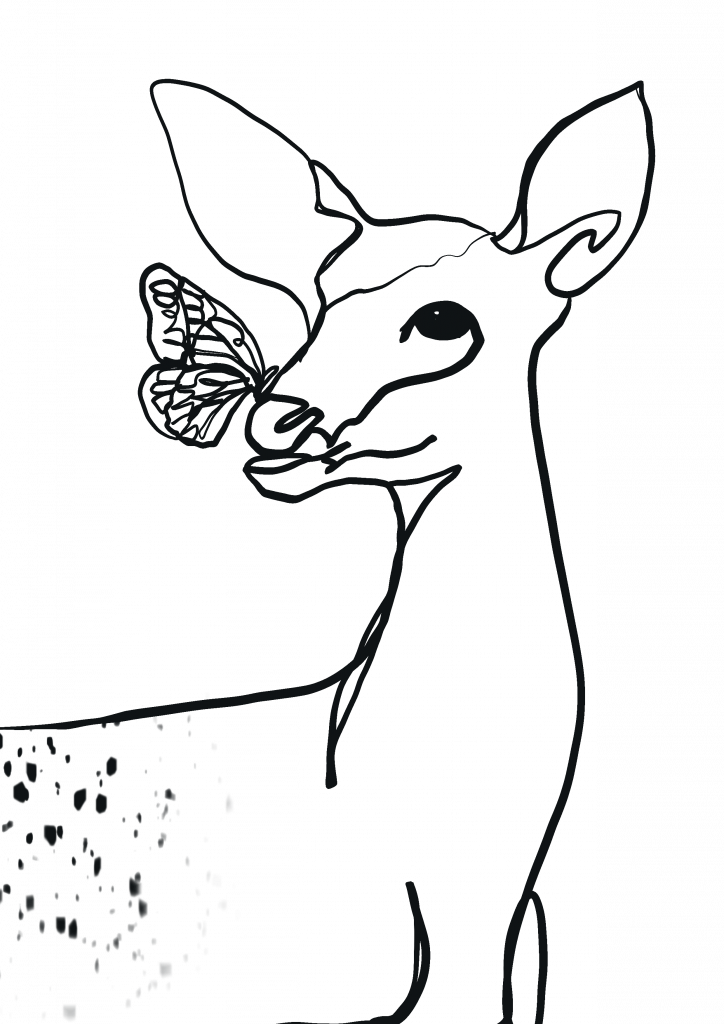
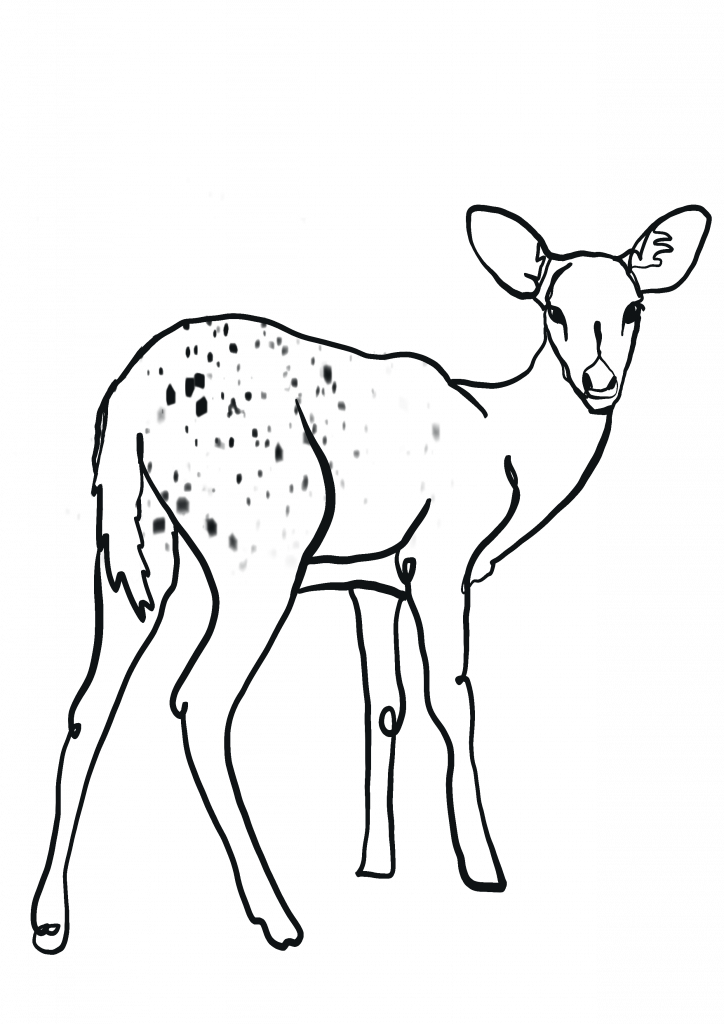
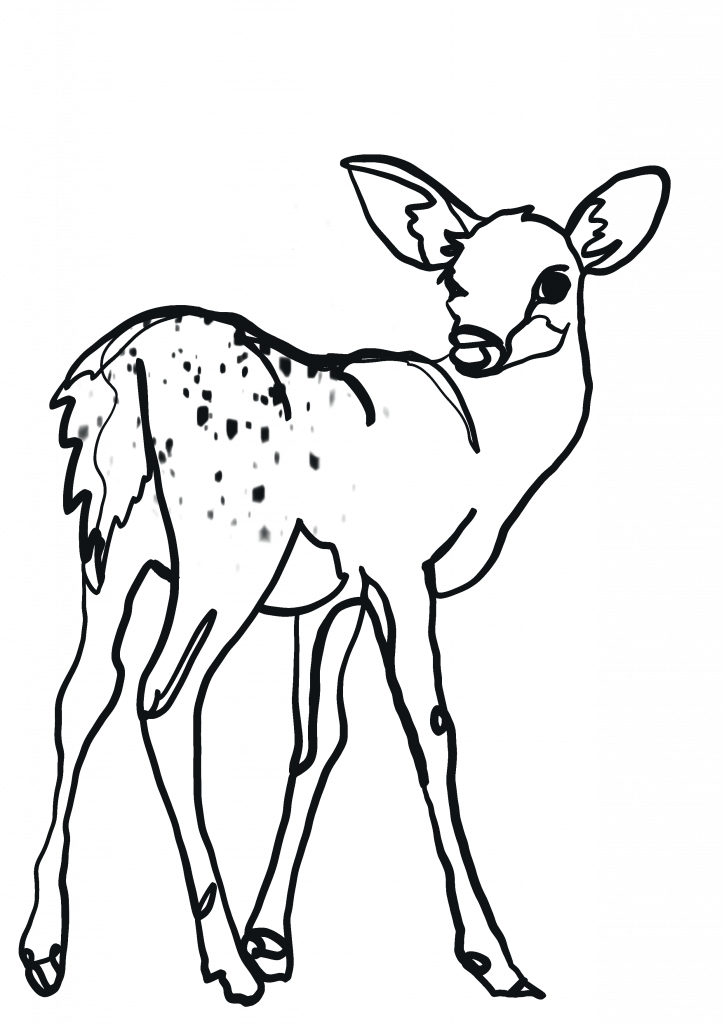
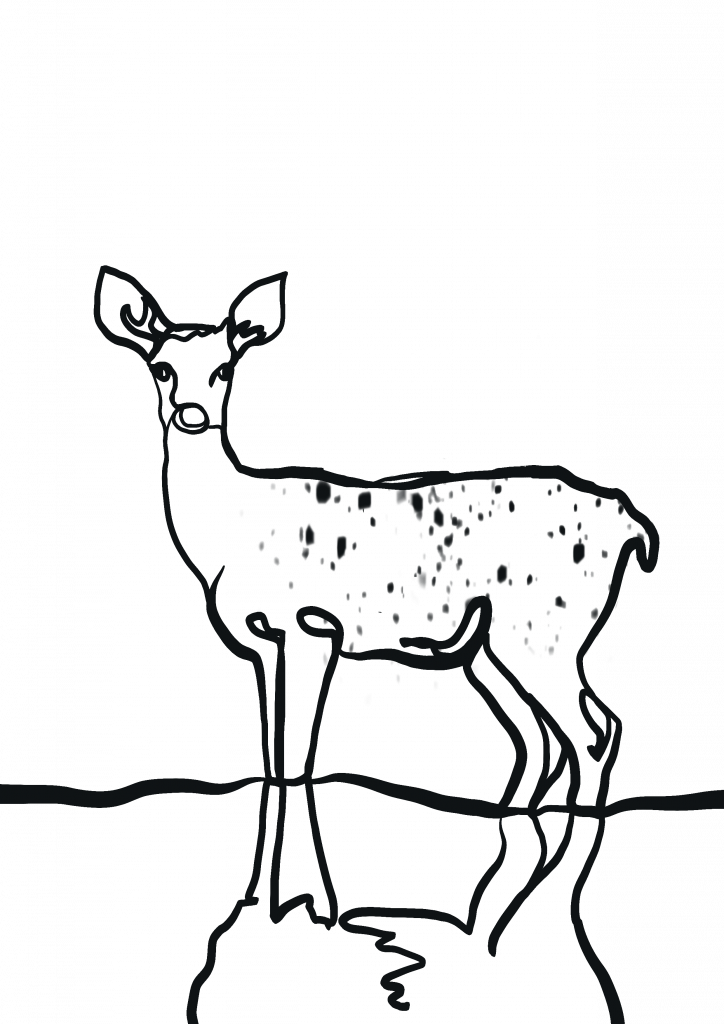
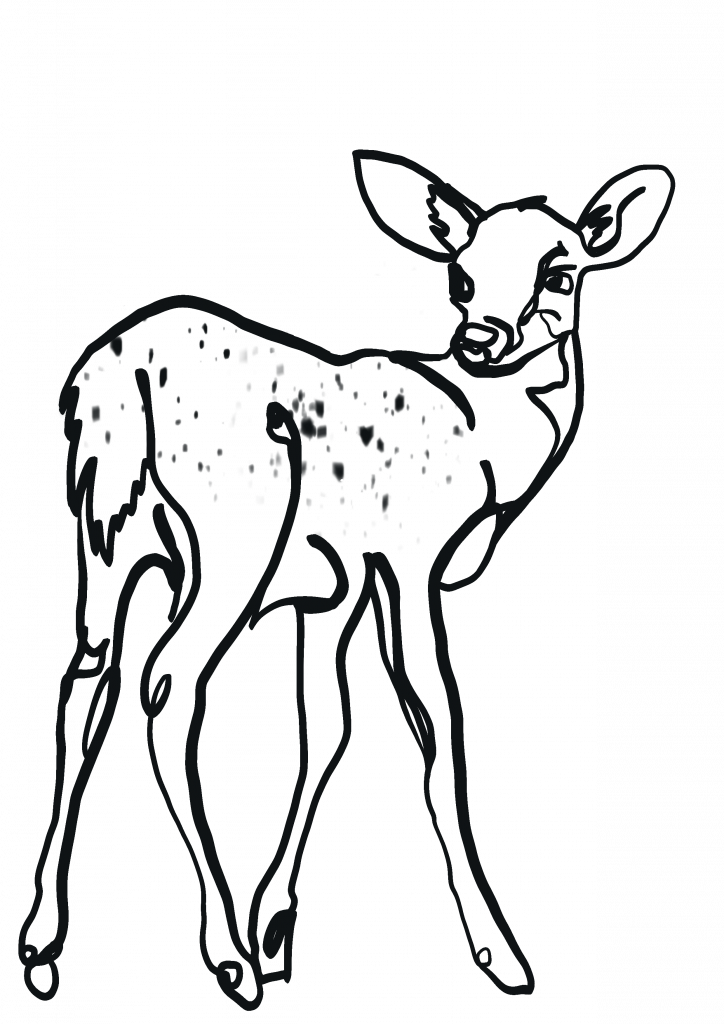
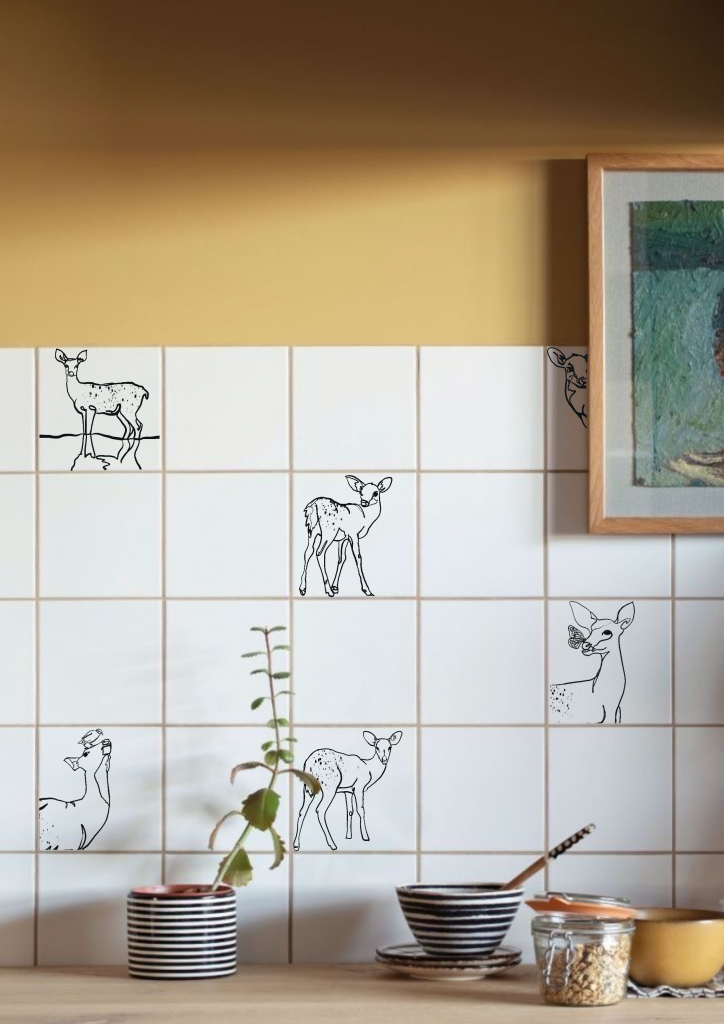
    Having created 30 postcards of quick drawings, I was feeling inspired by the technique of single line drawings. With that in mind I did 5 quick single line drawings and placed them on tiles in a photo mockup.

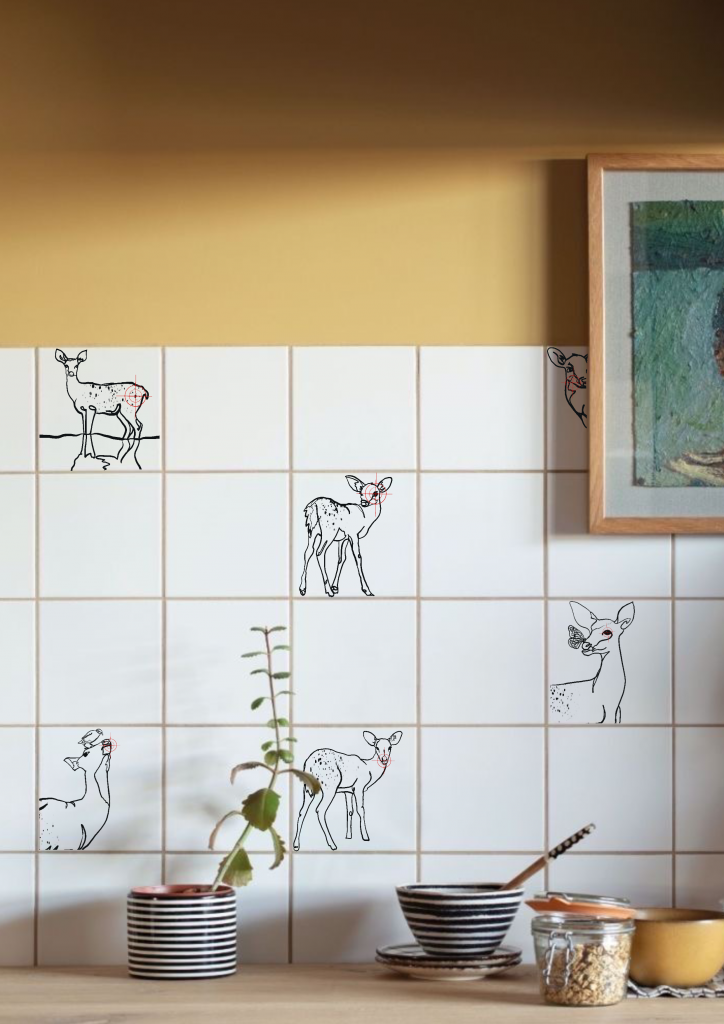
    The Mockups

    I started with the images of the deer on the tiles before adding the protest element

  • 15/10/25

    BAIVM, Year Three, Block One 

    Independent Study Task

    Tutorial Time: ……………. 

    When you are not in your group tutorial, please complete the following tasks:

    Today:

    Create a mind map using the following words as launch points:

    Museum Dreaming: LOCATION / COLLECTIONS / INTERVENTION / ACTION

    Sub TV: AUDIO / VISUAL / HARMONY / JUXTAPOSITION

    Living / Live-in Archive: FORM / FUNCTION / NARRATIVE / MATERIAL

    Reflect on this, highlighting opportunities to explore further practical, theoretical and technical knowledges. During the research trip gather photos/drawings/soundscapes/interviews/objects/ephemera and add to the mind map with references, artists, writers, musicians, exhibitions, questions etc. 

    For next Wednesday:

    Here’s a reminder of the client’s expectations:

    SubTVLiving / Live-in ArchiveF.A.T Studio
    Concept development.Storyboards.Style frames.Mock-Ups.Inspiration.
    Research, context & background.Early sketches.
    Visualisation of ideas.Material tests.Early prototypes. 
    Inspiration, research, context 
    & aim.Sketches, illustrative style & visual languageInitial mock-ups & early prototypes.
    1. Write a short paragraph (no more than 200 words) that communicates your concept.
    2. Begin to create the relevant client requirements that showcase the client expectations.
    3. Bring these documents to the work in progress feedback session.

    Client’s requirements for work in progress feedback:

    SubTVLiving / Live-in ArchiveF.A.T Studio
    2 x A3 print outs that showcase the client expectations, including 200-word description.Device with any moving image experiments.2 x A3 print outs that showcase the client expectations, including 200-word description.Supporting material tests and early prototypes. 2 x A3 print outs that showcase the client expectations, including 200-word description.Initial mock-ups & early prototypes.

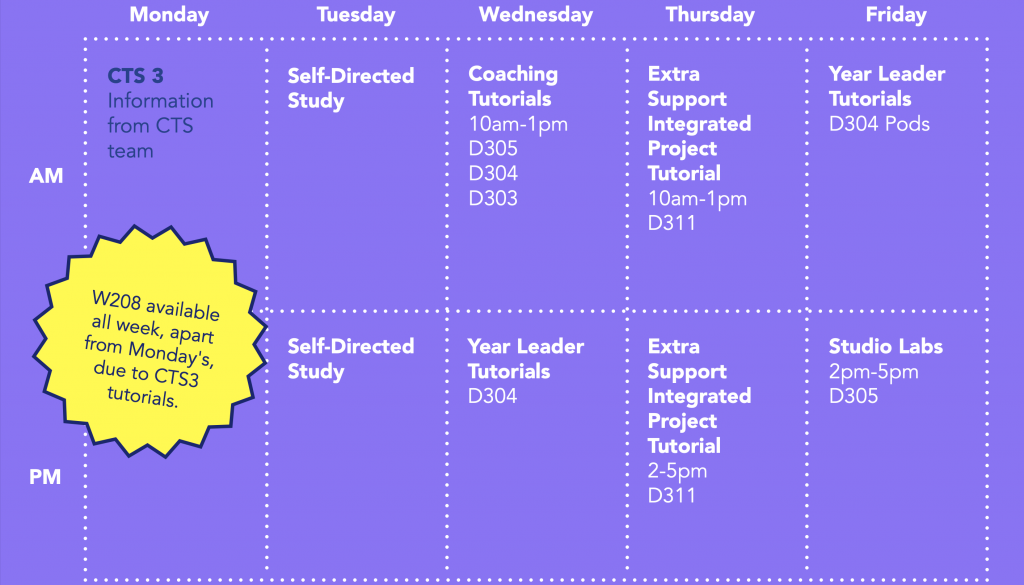
    These tasks are to be completed during the Wednesday coaching session outside of your group tutorial time. You can also use them to support your independent practice before your Lab on Fridays. 

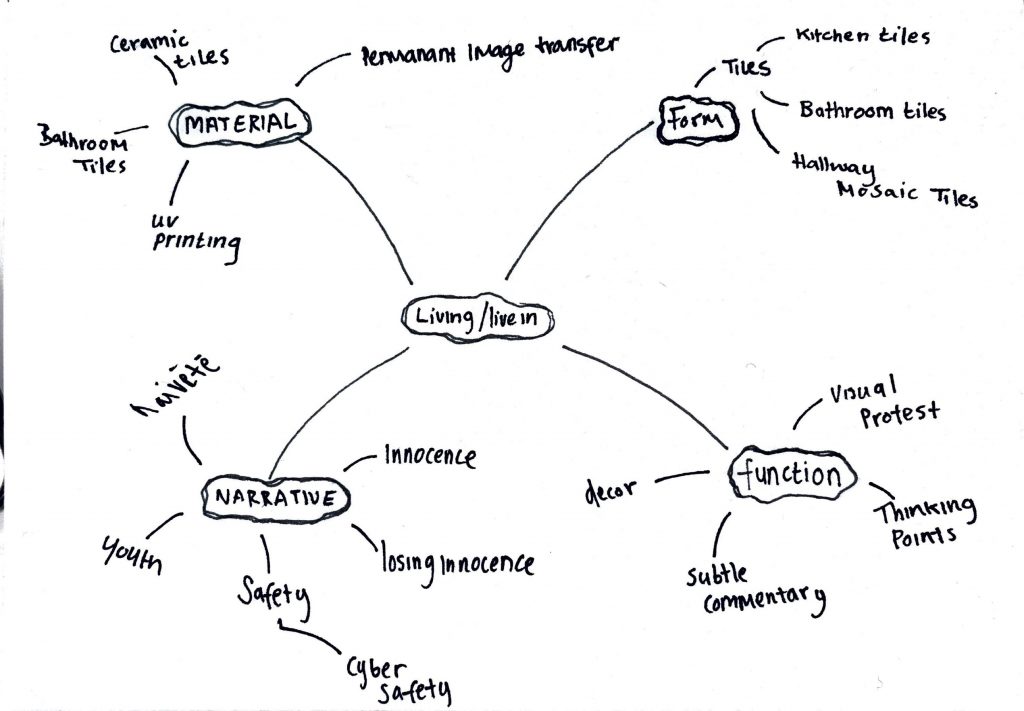
    Mindmap

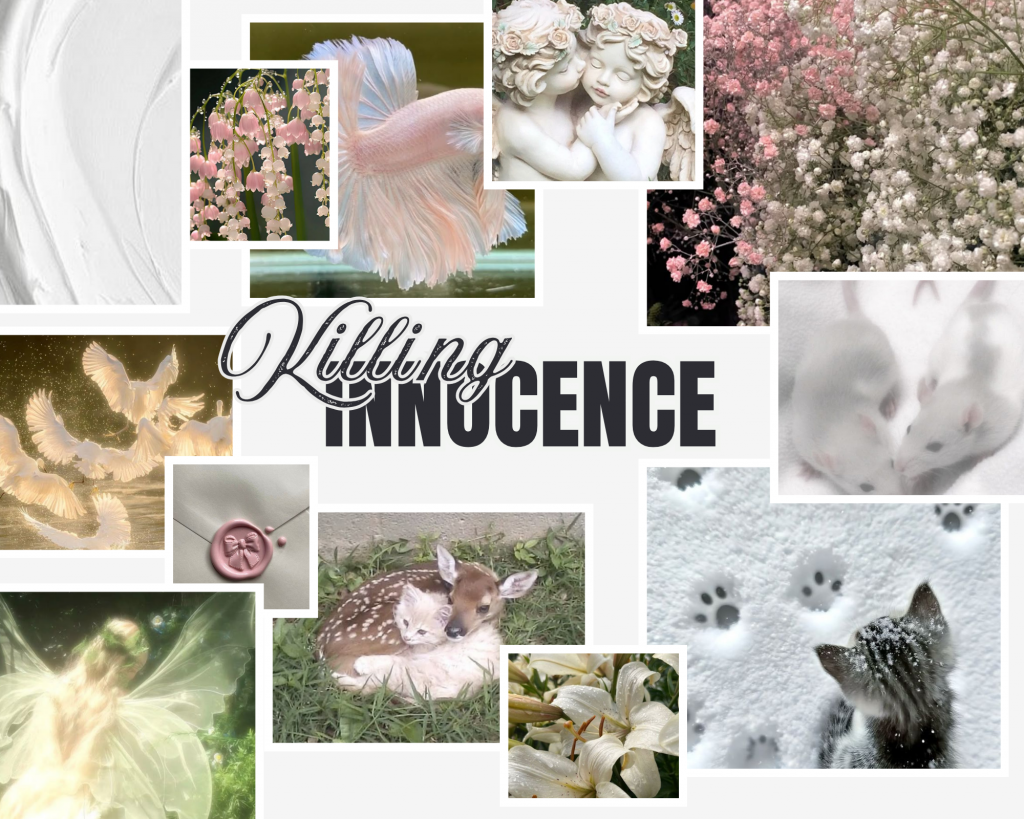
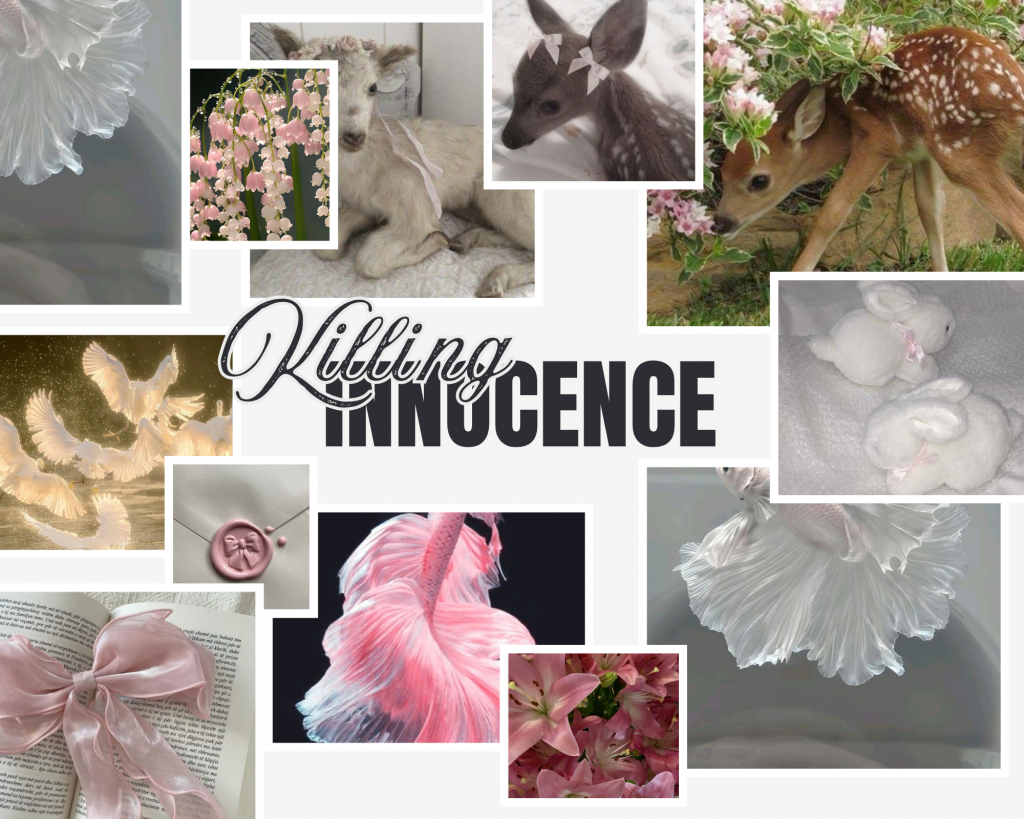
    Symbols of Innocence

    • White
    • Dolls
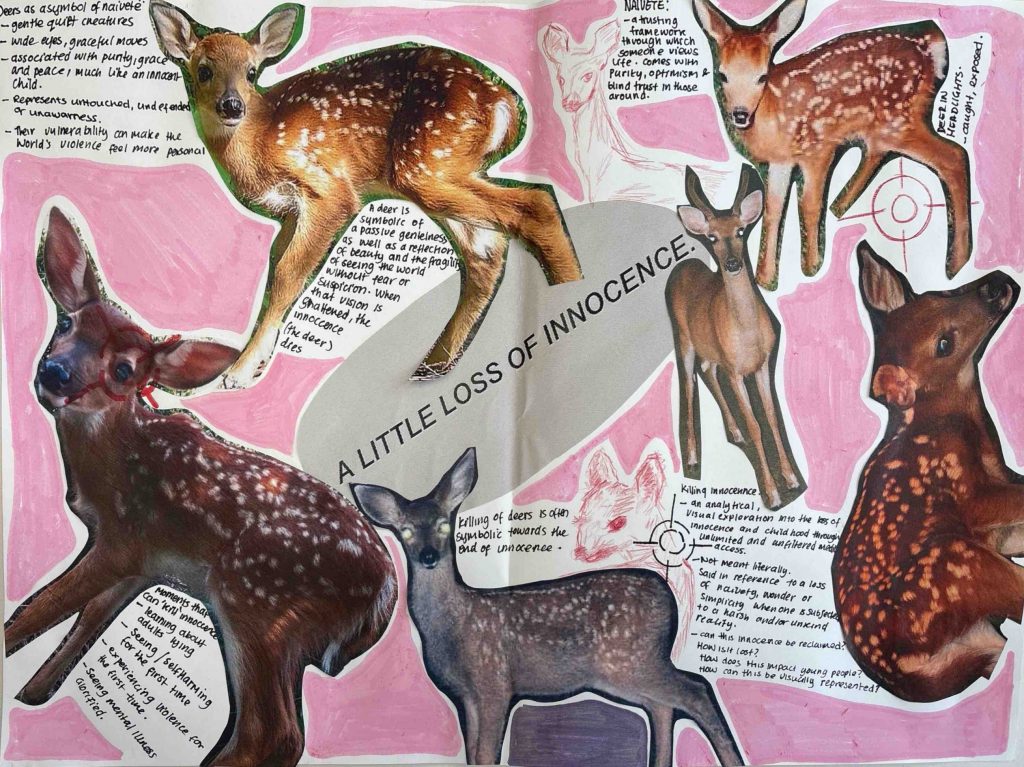
    • Deers
    • Bunny rabbits
    • Bows
    • Cherubs/Angels
    • Angel Fish
    • Doves
    • Teddy bears
    • Lily Flowers
    • Lily of the valley
    • Lambs
    • Fairies
    • The moon
    • ladybirds
  • Enquiry

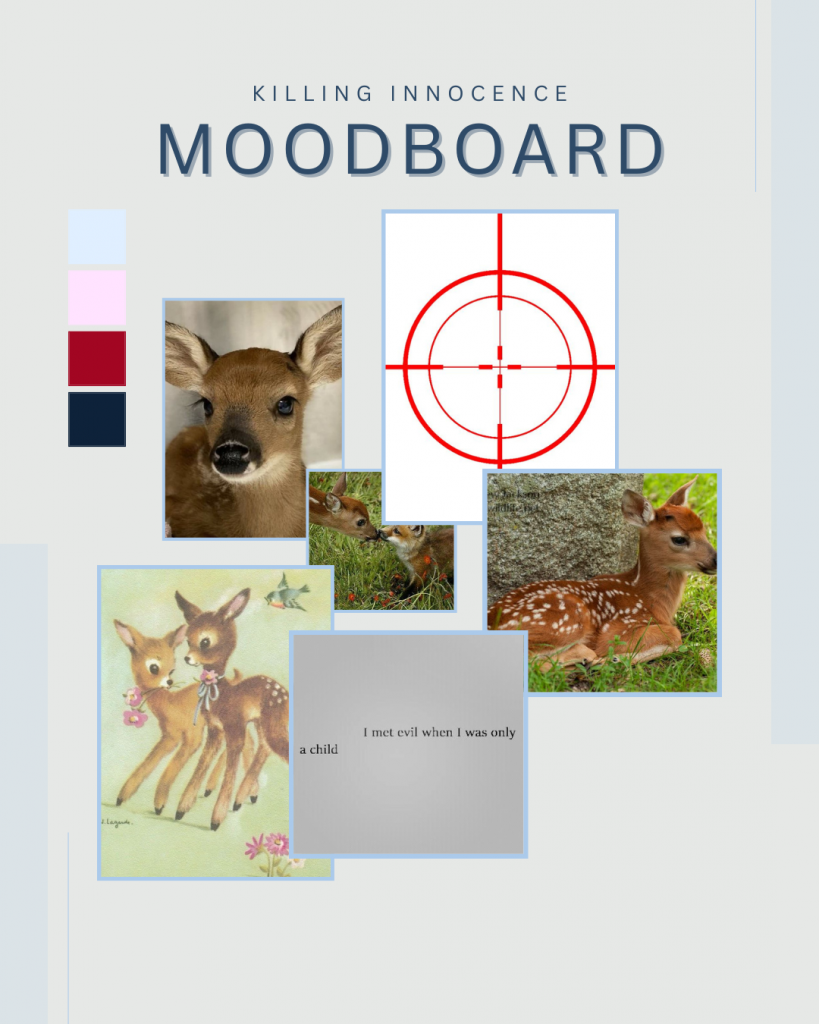
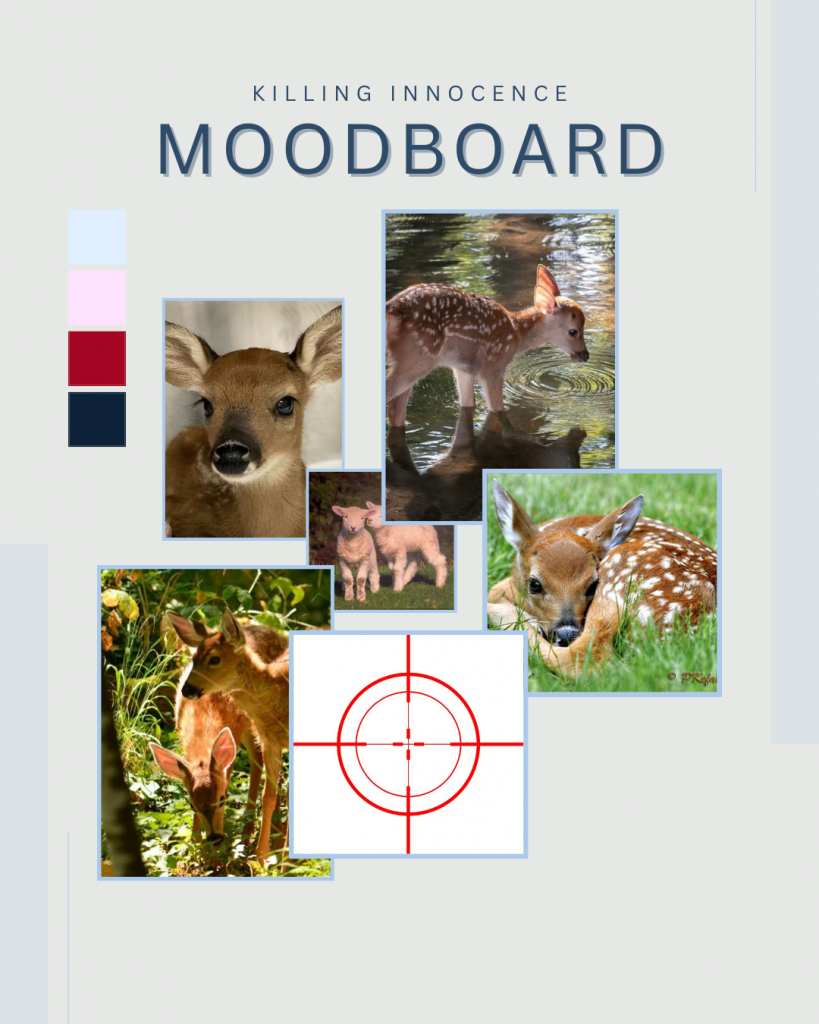
    Moodboards

    Loss of innocence in literature

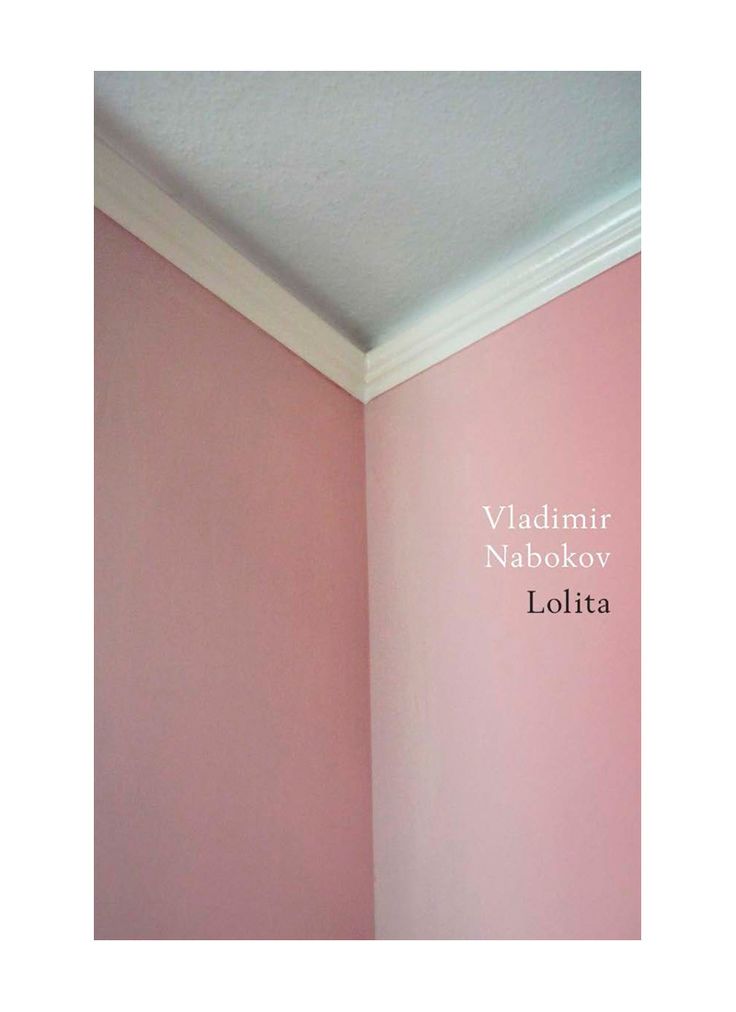
    Lolita by Vladimir Nabokov (1955)

    This novel follows the life of protagonist Humbert Humbert, who after losing the girl he loved, became obsessed with physical relationships with girls aged 9-14. The portrayal of this is shown in his relationship with his step daughter Dolores, nicknamed Lolita. The book follows his early encounters, meeting Dolores, marrying her mother, the start of sexual abuse, Stockholm syndrome from Dolores and the inevitable fall. This book remains relevant to my project theme as many young girls today are subjected to behaviours far their senior through social media. Their naïveté is then lost through older men and women who take advantage of their innocence as was the case with Humbert and Dolores in ‘Lolita”

    Loss of Innocence in Media

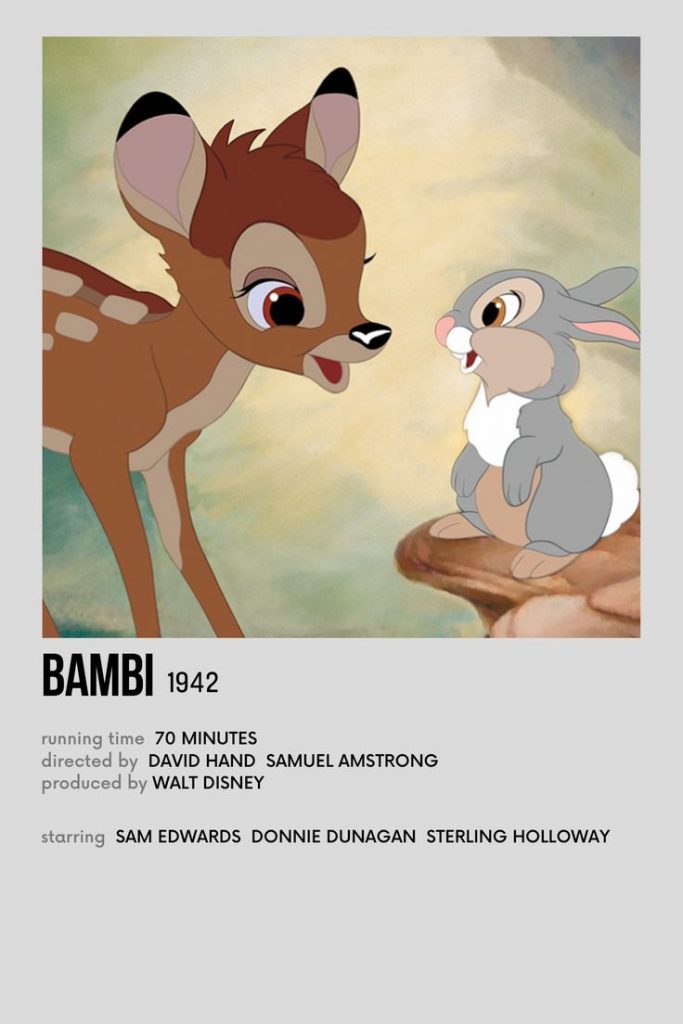
    Bambi is a classic Disney film that tells the story of a young white tailed deer named Bambi as he grows up in the forest. Born to the Great Prince of the Forest, Bambi starts life as a curious and playful fawn. Tragically his mother is shot by humans in front of him and he is left to fend for himself. He quickly befriends other woodland creatures, including Thumper the rabbit, Flower the skunk, and a young doe named Faline.

    As Bambi grows, he learns important life lessons about friendship, love, and survival.Through the lose of his mother and the sudden need to grow up alone, Bambi loses his innocence and matures.

    Later, as an adult, Bambi must face new challenges, including rivalries for Faline’s affection and the dangers of man’s continued presence in the forest. Eventually, he proves himself by saving Faline and leading the forest animals to safety during a fire.

    The movie ends on a hopeful note, with Bambi taking his place as the new Great Prince of the Forest, watching over the next generation.

    This movie shows the loss of innocence through the killing of the protecter leaving the protected to fend for itself. The deers are gentle creatures by nature and this movie showed how the dangers of hunters affects the lives of these deers. As with “Lolita’, this theme remains prevalent today with many young people losing their protecters, or being mistreated by those supposed to protect. As with young deer, their naïveté leads to blind trust and as with Bambi some have to learn how live after losing that.

    Loss of Innocence in Contemporary Art

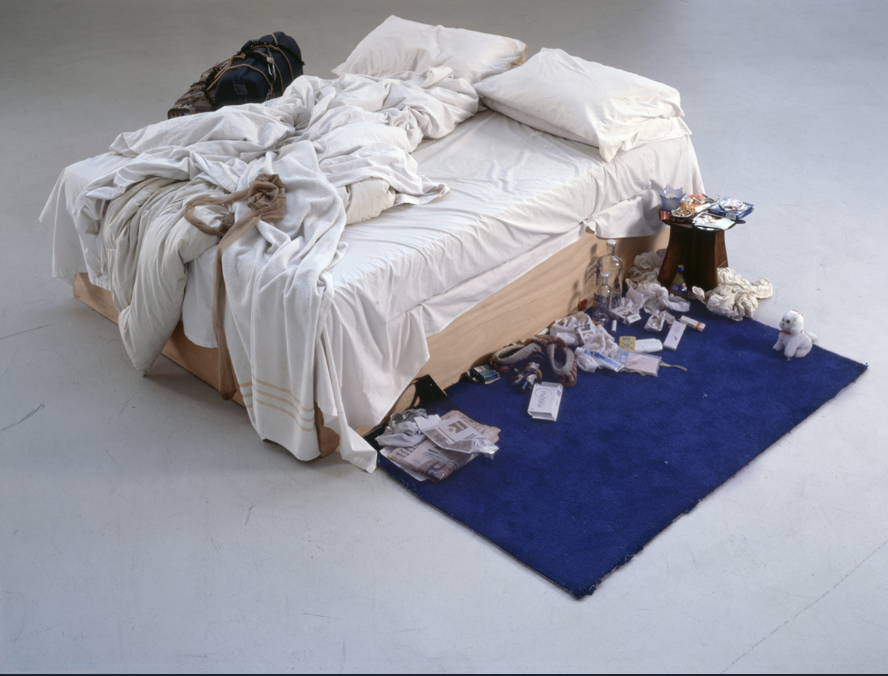
    Tracy Emin ‘My Bed: Everyone I’ve slept with’ 1998

    Described as a ‘provocative sculpture’, Tracy Emin’s ‘My Bed’ explores themes of trauma and heartbreak using her own bed and surrounding memrobillia to represent the mental process she went through following the end of a relationship. Items within the sculpture included innocent things such as a pair of slippers or polaroids. These were then contrasted by empty vodka bottles, used condoms and cigarette butts, examples of a lack of innocence. While this piece doesn’t directly talk about the loss of innocence, its narrative is easily associated with the non innocent and it is that, that I am inspired by within this piece.

  • 08/10/25

    Client expectations:

    research / context / background / inspiration

    Early sketches / Visualisation of ideas

    Material test / Early prototypes

    Enquiry

    Extensive contextual and theoretical independent research.

    Critical analysis and evaluation of the research to create a visualisation.

    • Movies /
    • Books /
    • Essays /
    • Bathroom graffiti /
    • History of protest /
    • How is innocence lost /
    • Media access/

    Studio Task

    BAIVM, Year Three, Block One 

    Independent Study Task

    Unit Assignment: Minor Project & Integrated Practice

    Tutorial Time: ……………. 

    When you are not in your group tutorial, please complete the following tasks:

    1 – Using the Library or online resources, begin research into your chosen Live Brief and Making Theory Projects. 

    2 – Begin to populate your blog with this information, under the heading ‘Enquiry’.

    3 – Create at least 20 photocopies/print outs of your initial visual research and inspiration. This will be used as collage material in Fridays Studio Lab. 

    Enquiry:

    Initial mind map

    Initial ideas / Subtle commentary on the loss of innocence and ease of accessing harsh realities through media / Using symbols of innocence, peace, naivety (deers, doves, rabbits) mixed with visuals of danger, harshness, unkindness (target signs, the colour red, guns, anarchy) / Represented through a series of tiles that initially look beautiful / Drawings of deer in a traditional analogue way / When examined closer, viewer sees a subtle change to the image that changes the context of the image

    How is innocence lost used in media, film and literature / William Blake (songs of innocence and experience) / To kill a mockingbird / Bambi / Lolita / William Morris house / social injustice / Kiki Smith

  • Minor Project 03.10.25

    F.a.t studio brief:

    Engagement Resource –  a tool, material, or service designed to facilitate and improve interaction, involvement, or participation from a specific audience.

    • Information cards
    • Sketchbooks
    • “things to do” leaflets
    • Infographics

    Ways I could work:

    • Taking an autistic child round the museum cards
    • Learning difficulties at the museum
    • “How does this make you feel” Workshop – ways of working through mental health using art already made
    • Guide to the museums on exhibition road

    Concerns: Not accessible to everyone, limiting it as an engagement resource for loads of people. Focus on mental health etc can be difficult on a family centred model as most families would choose to keep that private and hidden

    A Living/Live in Archive

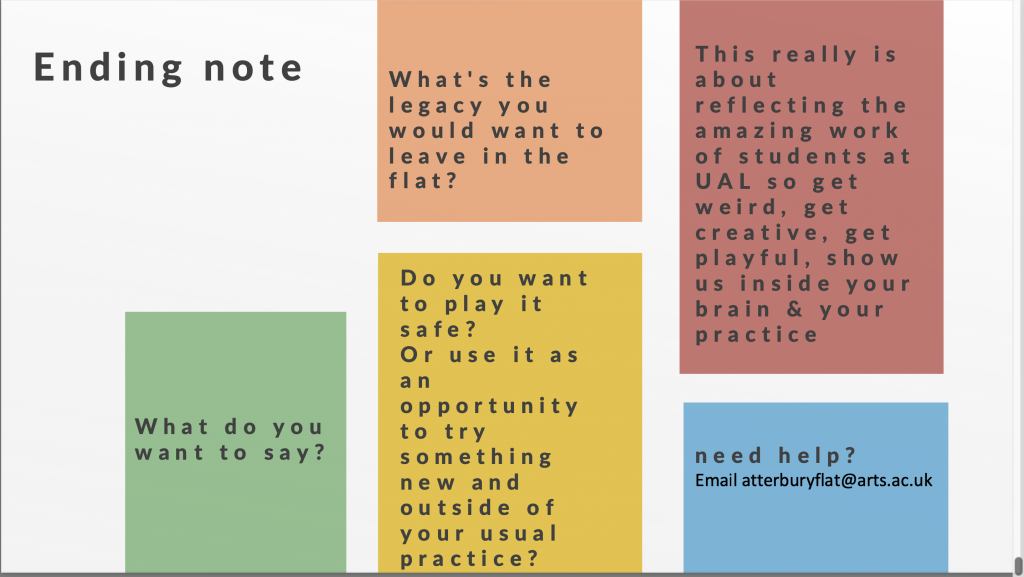
    What can I leave in this space that represents me, my practice and my theories? How would I navigate sensitive topics?

    Situation self in specific context – what are the barriers and how will I navigate that?

    uncomfortable, difficult, socioeconomic topics – how to display sensitive messages

    installation/event may be more appropriate

    • social/political engagement – however it’s represented should be indicative of who I am
    • Exploration of positive visuals of food/drinks
    • Consider what makes a space feel lived in for me – art on counter tops, books as placemats, mugs left sitting around

    What products exist in a home? Or flat?
    We’re looking for everything from board games & tarot decks, to a library of publications and zines.
    Bath salts to perfume, deck chairs to toilet roll holders, cookbooks, to curtains, to door handles to light switches…

  • Minor Project 01.10.25

    Year 3 Studio W208
    code: C23895

    Contextual and Theoretical Studies 3: 10,000 words (40 credits)

    +
    Minor Studio Project (20 credits)
    +

    Major Project (60 credits)

    Learning Outcomes

    Enquiry –

    Knowledge –

    Process –

    Communication –

    Realisation –

    Minor Project Briefing

    Please note, there will be a cap of 22 students per project option.

    At 10am on Monday 6th October, you will be sent an email in which you can choose your option.

    Live Brief Top Choice

    Museum Dreaming: The Brief

    Exhibition Road is home to many of London’s largest museums and galleries and in this brief, you will be asked to create a new engagement resource for families for a museum/gallery of your choice within this area.

    Museums and galleries have a long and rich history of commissioning artists/designers to create ‘engagement resources’ for families who visit their spaces. Typically, the ‘resources’ are printed booklets that give prompts and ideas for things to do whilst visiting the museum/gallery. But sometimes the resources can be more experimental in form: specially designed gadgets, audiotracks or even costumes.

    This brief welcomes you to create a resource that functions as an ‘aid’ and helps family groups engage creatively with the museum’s/gallery’s collections and create one of the following options:

    Option 1: Printed Resource (Option 1)

    Option 2: Experimental Resource

    This could be an activity, game, narrative etc. but the design must factor in that the resource would need to be accessible to large numbers of people, so it would need to be easily reproducible or extremely robust.

    Deliverables

    Option 1: Printed Resource • Double sided print
    • Max size: A3
    • 300dpi

    • 10 copies

    Option 2: Experimental Resource
    • To be defined with support of your tutor

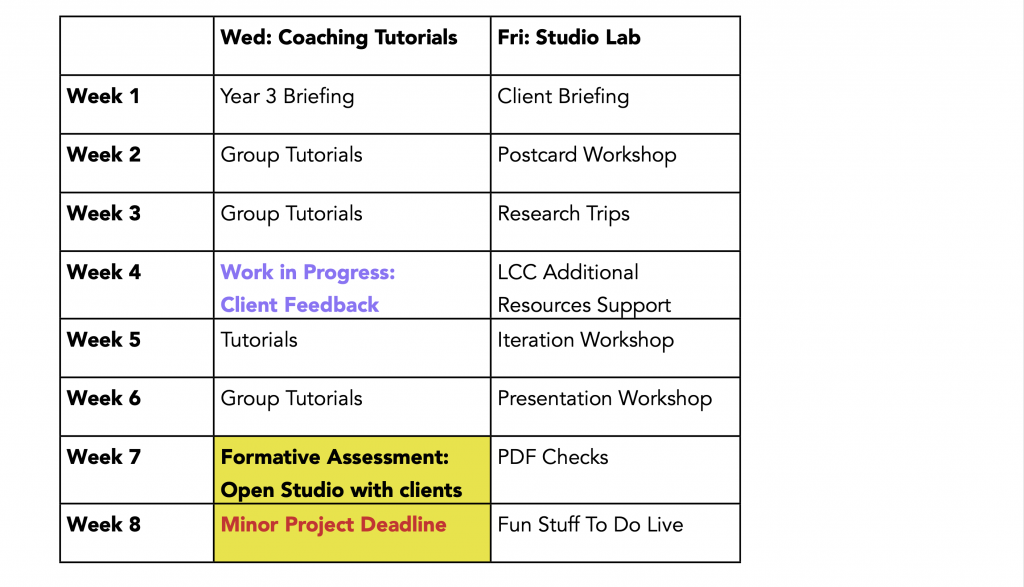
    As part of your formative assessment, there will be an Open Studio on Wednesday 12th November 2025 in which you will showcase this work to the client.

    (V&A museum map of information in style of trifold/zine)

    Live Brief Second Choice:

    Living / Live-in Archive The Brief

    The ‘Living / Live-in Archive is a year long project led by
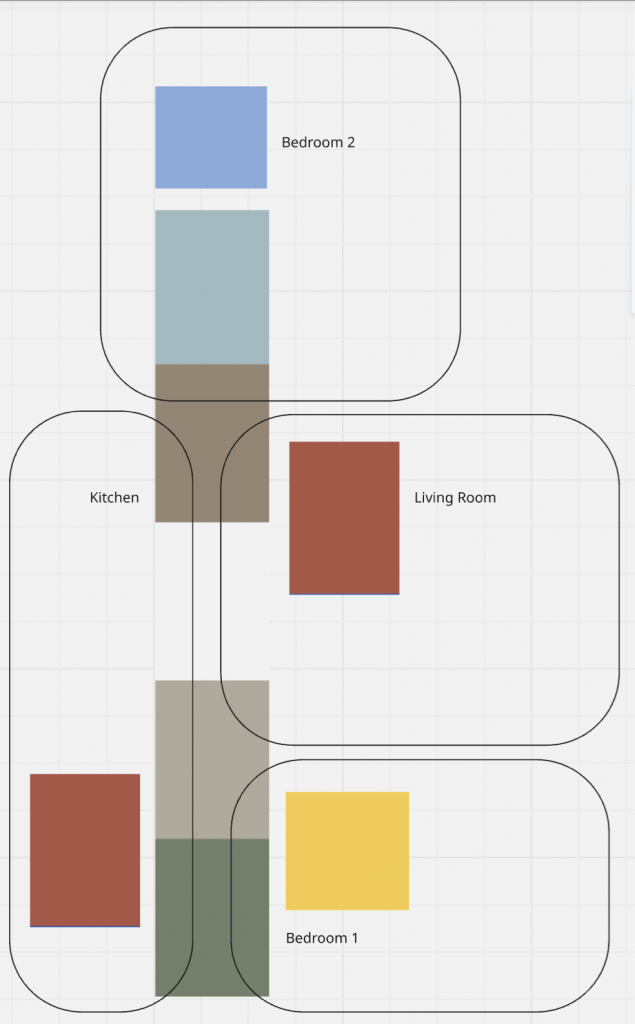
    Zoë Tynan-Campbell that invites students and graduates to completely reimagine the Atterbury flat. A two bedroom flat at Chelsea College of Arts which is used to host esteemed guests. Currently a blank canvas, everything in the space will be designed and made by students and graduates of UAL. Creating a rich space that is as much an archive and library of wild and wonderful objects as it is a functional living space.

    This brief welcomes you to be a part of this enterprise. You must consider the space / location in which your work would be displayed (a particular room / ceiling / cupboard) and select one of the following options to work within:

    Option 1: Surface Design
    Wallpaper, Soft furnishings, Tiles, Murals, etc
    (Option 3)

    Option 2: Object Design
    Furniture, Kitchenware, Ceramics, Books, Wall Art, etc
    (Option 2)

    Option 3: Spatial Intervention
    Performance, Installation, Projection, Event, etc

    Although there is no strict theme, you may wish to use the following key words as inital inspiration: HOME / HABITAT / LEGACY / LEARNINGS.

    Deliverables

    Inspired by the format of Design Festivals your deliverable will be a physical display, showcasing the outcome/s of your chosen option.

    It is important that these are real physcial 3D outcomes and not mock-ups of your designs.

    As part of your formative assessment, there will be an Open Studio on Wednesday 12th November 2025 in which you will showcase this work to the client.

    .

    Work for this week:

    • Your chosen client brief.Why did you choose this?

    • Initial research & enquiryPlease bring a selection of physical and digital resources.

  • Hello world!

    Welcome to myblog.arts. This is your first post. Edit or delete it, then start blogging!